
Reviewed · HELICOPTER TOURS
Mount Cook: Mountains High 40-Minute Helicopter Flight
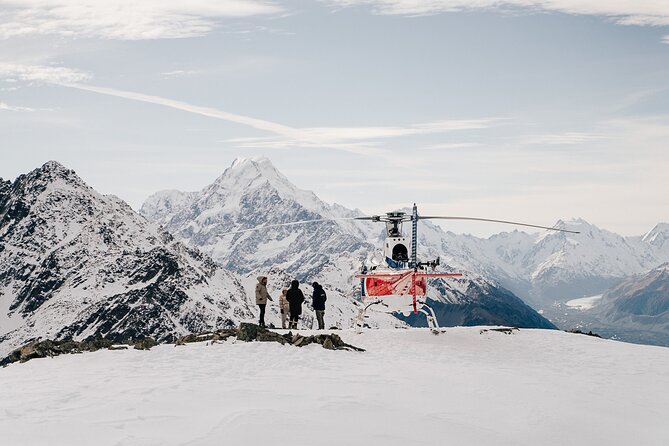
A snow landing on Tasman Glacier is the heart of this 40-minute helicopter flight. You leave Glentanner Park, pass over Hochstetter Icefall and the upper Tasman Glacier, then step out onto a high alpine snowfield with Aoraki/Mt. Cook close by. It is a quick flight, but it reaches country that would take serious effort to visit on foot.
I like two things here: the small maximum group of six, which gives everyone a good chance at a window, and the range of scenery packed into one loop. You see ice, high peaks, rugged mountains, waterways, and the dry Mackenzie Basin in a single outing. The main caution is that a snow landing depends on weather, season, and snow conditions, so it is not guaranteed every day.
Key points at a glance
- A 5 to 10-minute snow landing gives you time to step out, take photographs, and feel the cold alpine air.
- Aoraki/Mt. Cook reaches 12,217 feet, creating a powerful backdrop from the Tasman Glacier area.
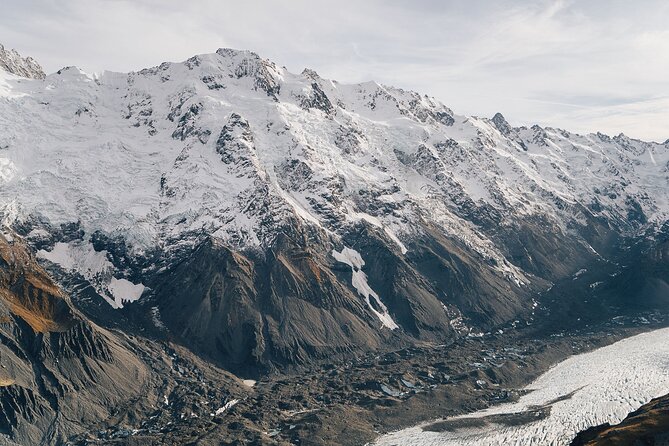
- Hochstetter Icefall and the upper Tasman Glacier are viewed from the air before the landing.
- The return route crosses the Burnett Mountains and Mackenzie Basin, adding dry inland scenery to the glacier flight.
- The helicopter carries up to six people, with an open-plan cabin designed for viewing.
- Weather can change the plan, including the landing site, flight route, or departure time.
Why the Tasman Glacier landing matters
A helicopter flight can easily become a quick sightseeing loop with pretty views and little sense of place. This trip has a stronger purpose because it gets you onto the ice and snow itself. Even a 5 to 10-minute stop changes the experience from simply looking at the Southern Alps to physically standing in that alpine setting.
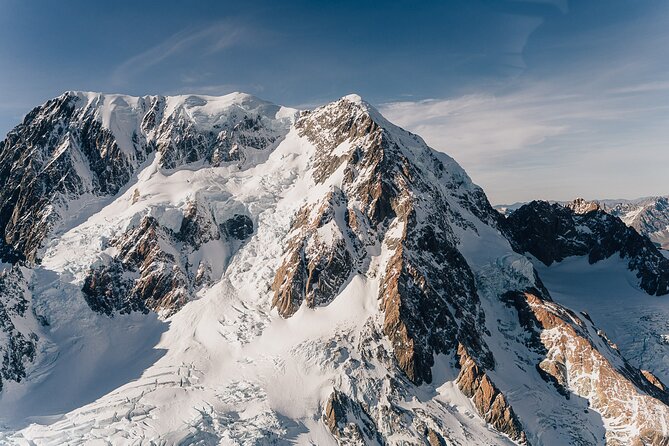
The landing area is above the Tasman Glacier, with Aoraki/Mt. Cook in view when conditions cooperate. At 12,217 feet, New Zealand’s highest mountain gives the scene its scale. The mountain is not just a distant triangle in the window. From the snowfield, it forms part of a much larger world of ice, ridges, and steep rock.
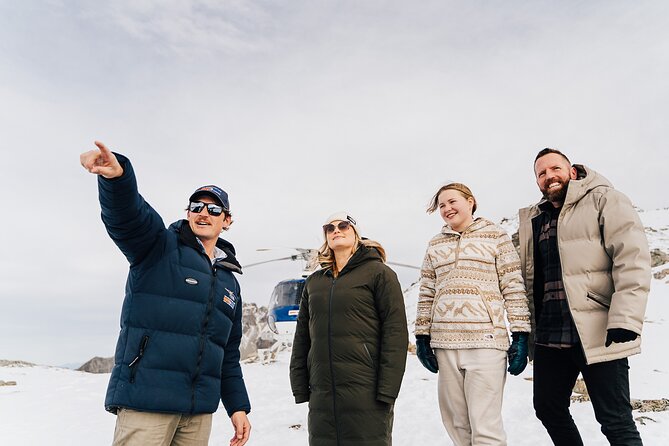
You should expect cold temperatures at the landing site. Wear warm clothing and sturdy, suitable footwear, even if the weather feels mild at the base. There is no long walk included, but the surface and conditions are alpine rather than polished or urban.
The landing itself is one of the most memorable parts of the outing, but it needs a little qualification. Snow cover varies with the season, recent winter snowfall, and current conditions. A flight may land on an ice field or another suitable alpine area instead of a snowy glacier site. If standing in fresh snow is the main reason you want to book, ask about current landing conditions before paying.
More Helicopter Tours in Mount Cook
- Mount Cook: Scenic Helicopter Flight with Alpine Landing
★ 4.8 · 442 reviews - Mount Cook: Ski Plane and Helicopter Glacier Combo Flight
★ 4.6 · 271 reviews - Mount Cook: 3-Hour Tasman Glacier Helicopter Ride and Hike
★ 4.9 · 235 reviews
From Glentanner Park to Hochstetter Icefall
You make your own way to The Helicopter Line base at Glentanner Park on State Highway 80. The flight returns to this same meeting point, so you do not need to arrange a separate pickup or find your way back from the mountains.
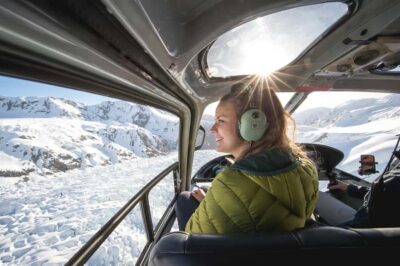
Once aboard, the pilot becomes both your flight guide and your source of regional information. The cabin has an open-plan design and carries no more than six people. That small capacity matters in a helicopter. You are not looking through a crowded coach window, and the cabin arrangement gives you a direct view of the peaks and glaciers.
The first section heads toward Aoraki/Mt. Cook and the Tasman Glacier. From above, the glacier becomes a broad field of ice rather than a narrow river of snow. You pass the Hochstetter Icefall, one of the striking features on the mountain, then continue toward the upper Tasman Glacier.
The flight is scenic rather than a point-to-point transfer, so the pilot can guide your attention to natural features along the way. Clear weather makes a large difference. On a cloudless day, you can see the major peaks and glaciers with much more definition. In poor conditions, the same route may offer a more limited view, or the flight may be postponed.
The snowfield stop above Tasman Glacier
The helicopter hovers over the ice before making a soft alpine landing. You then have a short period outside, usually 5 to 10 minutes, to take photographs and look across the surrounding peaks.
This is not a glacier hike. You should think of it as a brief mountain landing, not a walk across the ice or a guided snow excursion. The value comes from the setting and the access. The helicopter places you in a remote alpine area without requiring a strenuous climb or a full-day commitment.
A short stop can feel surprisingly complete. You get the engine noise, the sudden quiet after the helicopter lifts away, the cold underfoot, and a view that is difficult to replicate from the valley. The landing also gives you a chance to take photographs without shooting through glass.
There are practical limits. The stop is brief, and conditions may make the landing location different from the one you imagined. One flight had to use an ice field rather than a glacier because of strong mountain winds. Another did not include the advertised snow landing because seasonal conditions did not allow it. The operator may alter the landing for safety, and that decision is more important than keeping the brochure version of the route.
Aoraki/Mt. Cook from a rare angle
The mountain view is the visual anchor of the flight. From the Tasman Glacier area, Aoraki/Mt. Cook rises above a setting of ice and high ridges. The perspective changes quickly from the helicopter, where you see the mountain in relation to the whole alpine region, to the landing site, where the peaks feel much closer.
The pilot commentary adds useful context. Guides named in the feedback include Gillie, Richard, and Marcus, and the strongest experiences paired clear scenery with explanations of the area and its history. That narration helps you understand what you are seeing rather than simply collecting mountain photographs.
Headset quality is worth noting. At least two people found the pilot difficult to understand through their headsets, and one group found that some headsets did not work. This is not a problem for every flight, but it can reduce the value of the commentary. If you cannot hear, tell the crew rather than quietly missing the information.
Seating can also affect the view. The helicopter has two front seats and four rear seats. One booking party was told that seats would rotate after the landing so people in the rear could sit at the front, but other passengers did not follow the arrangement. Ask the staff to explain the seating plan clearly before takeoff, especially if front-cabin time matters to you.
More days out at Aoraki Mount Cook:
- Mount Cook & Lake Tekapo Day Tour from Christchurch
★ 4.9 · 483 reviews - Mt Cook Small Group Scenic Day Tour from Queenstown
★ 5.0 · 407 reviews - Mount Cook, Lake Tekapo and Tasman Glacier Tour from Christchurch
★ 5.0 · 353 reviews - From Christchurch: Mt Cook Day Tour & Lake Tekapo
★ 4.6 · 331 reviews
Across the Burnett Mountains and Mackenzie Basin
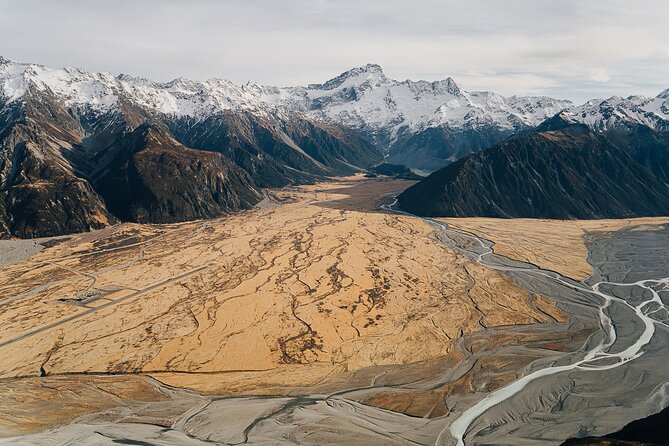
After leaving the landing site, the route crosses the Burnett Mountains. This section gives the flight a useful change of pace. The Tasman Glacier is all ice and high alpine scale. The Burnett Mountains and Mackenzie Basin show a broader, drier side of the South Island.
Below, the Mackenzie Basin opens into a wide inland area with rugged ground and sparkling waterways. The route then takes in views toward native rainforests on the West Coast. You get a sense of how quickly New Zealand’s scenery shifts from snowy summits to dry pasture and then toward wetter forested country.
That variety is one of the better reasons to choose this particular flight instead of a very short peak-only trip. In about 40 minutes, you see several distinct environments. You also gain a clearer sense of how large the Southern Alps are. From the valley, the mountains can look like a single wall. From the air, they become a connected system of glaciers, passes, basins, and ridges.
The route is still weather dependent. Wind, cloud, and visibility may lead to a modified flight path. One booking expected a route involving Fox and Franz Josef Glaciers, but the actual experience described here is the Aoraki/Mt. Cook, Tasman Glacier, Burnett Mountains, and Mackenzie Basin circuit. Check your confirmation carefully so you know which flight you are buying.
Is $416.90 a fair price?
At $416.90 per person, this is a major addition to a New Zealand holiday budget. It is not a casual sightseeing ride, and the cost may be hard to justify if you only want a short view from the air.
The value improves if you want three things at once: helicopter access, close views of Aoraki/Mt. Cook, and time on an alpine snowfield. A walking route cannot give you the same combination in 40 minutes, and a ground-based viewpoint cannot put you above the upper Tasman Glacier. The small group size and pilot commentary also add value.
Still, the price does not guarantee a particular landing site or perfect visibility. If clouds cover the peaks, the flight may be delayed, changed, or canceled. If the snow has receded, you may land on ice or another suitable field. You are paying for access and the chance to experience these conditions, not for a fixed photograph.
I would consider it good value for a special occasion, a first helicopter flight, or a short visit to the Mount Cook area when you want one major aerial experience. It is less compelling if you are already booking several scenic flights or if your budget is tight and you are happy with valley walks and viewpoints.
Weather, timing, and what to wear
The flight requires good weather. If poor conditions force a cancellation, you can choose another date or receive a full refund. The company may also cancel if the minimum number of participants is not reached, with a different date, another experience, or a refund offered.
Weather changes can also mean rescheduling rather than cancellation. One booking moved to a different day because of conditions, though communication about that change was not as clear as it should have been. I would keep some flexibility in your Mount Cook schedule and avoid placing this flight immediately before a fixed departure.
Give your preferred flight time when booking. The actual time depends on availability and operating conditions, but it is sensible to keep your day open around the flight rather than building a tight chain of plans.
Wear warm layers and suitable footwear. The base may feel comfortable while the landing site is cold. Personal items are not included, so plan for your own clothing and equipment. Children must be accompanied by an adult, and most people can participate, subject to the stated total passenger weight limit of 331 pounds per passenger.
If you have mobility concerns, contact the operator before booking. One family managed to help a physically disabled son into the helicopter using a small step stool and lifting assistance, but that account also shows that boarding may require real physical effort. The supplied details do not promise step-free access.
What the strongest experiences have in common
The most praised parts are consistent: spectacular mountain views, a memorable snow or ice landing, and pilots who explain what you are seeing. The flight can be especially good when the sky is clear. One party changed its timing to fly on a nearly cloudless day and found the decision worthwhile.
The pilot can shape the experience. Richard was praised for explaining the area and its history. Gillie was remembered for a flight that combined strong commentary with a brilliant snow landing, while Marcus was described as taking pride in explaining the route. Those details matter because a helicopter trip moves quickly. A good pilot helps you notice the icefall, peaks, and basin before the view changes.
The staff at the base have also been described as friendly, professional, and helpful. That is useful in a weather-sensitive activity, where clear instructions and calm handling make a difference.
The weaker points are practical rather than scenic. Headsets may be difficult to hear. A promised landing may not happen. Seating rotation should be clarified so the group shares the best front views fairly. These are not reasons to reject the flight, but they are good reasons to ask questions at the base.
Who should book this Mount Cook flight?
I would put this high on the list for anyone with limited time in Aoraki/Mt. Cook who wants a close look at the alpine region without committing to a demanding hike. It suits couples, families with older children, and anyone marking a honeymoon or major holiday. The combination of flight and landing feels like a genuine event rather than a simple transfer.
It is also a strong choice if you have never flown in a helicopter. The aircraft adds its own thrill, while the scenery gives the flight a clear purpose. You are not just circling a town. You are moving over glaciers, landing in high country, and crossing from the Southern Alps into the Mackenzie Basin.
You may want to skip it if you dislike small aircraft, cannot tolerate cold conditions, need a guaranteed snow landing, or would be upset by a weather-related change. You should also check the route description carefully if you are expecting Fox or Franz Josef Glaciers, since the Mount Cook flight described here follows a different circuit.
Free cancellation is available up to 24 hours before the start time. Inside 24 hours, the booking is nonrefundable, and changes are not accepted. That policy makes an early booking sensible only if you can protect the final day and keep your schedule flexible.
My verdict on the Mountains High flight
Book this tour if you want a compact, high-impact introduction to the Southern Alps. The best version gives you clear views of Aoraki/Mt. Cook, a 5 to 10-minute snow landing, strong pilot commentary, and a return over the Burnett Mountains and Mackenzie Basin.
Before you commit, confirm the route, ask about current snow conditions, and understand how seating will rotate. With those points clear, the $416.90 price can make sense for a once-in-a-trip mountain experience. Just remember that the mountain, not the brochure, controls the final details.
FAQ
Where does the helicopter flight begin and end?
The flight begins at The Helicopter Line base at Glentanner Park, State Highway 80, Glentanner 7999, New Zealand. It ends back at the same meeting point.
How long is the flight?
The total scenic flight lasts approximately 40 minutes.
How long do you stay on the snow?
The included snow or alpine landing lasts approximately 5 to 10 minutes.
Will the flight land on Tasman Glacier?
The planned experience includes an alpine landing above Tasman Glacier, but the exact landing site depends on weather, snow cover, seasonal conditions, and safety. A landing on ice or another suitable alpine field may replace a snow landing.
What places do you see from the helicopter?
The route includes Hochstetter Icefall, the upper Tasman Glacier, Aoraki/Mt. Cook, the Burnett Mountains, the Mackenzie Basin, waterways, and views toward native West Coast rainforests.
How many people can join the flight?
The helicopter carries a maximum of six travelers.
What should I wear?
Warm clothing and suitable footwear are recommended because temperatures at the alpine landing site can be cold.
What happens if bad weather cancels the flight?
You will be offered a different date or a full refund if poor weather causes the cancellation. Cancellation by the operator because the minimum number is not reached also allows a different date, another experience, or a full refund.
Just added around Mount Cook
- Queenstown to Lake Tekapo via Mt Cook One-Way Small Group Tour★ 4.5 · 13 reviews
- Queenstown to Mt Cook Small Group Tour (One-Way)★ 5.0 · 25 reviews
- Queenstown to Christchurch via Mt Cook (1 way) (Small Group)★ 5.0 · 6 reviews
- Queenstown to Christchurch One Way Tour Via Lake Tekapo & Mt Cook★ 5.0 · 10 reviews
- Mount Cook Day Tour from Queenstown★ 4.0 · 63 reviews
- Queenstown to Christchurch One-Way Tour via Mt Cook & Lake Tekapo★ 4.5 · 134 reviews
- Mount Cook Tour: Finish at Queenstown, Christchurch or Dunedin★ 5.0 · 3 reviews
- Mt Cook Tour & Ultimate Alpine Experience Combo from Queenstown★ 4.5 · 51 reviews
Helicopter Tours, compared.
Franz Josef Glacier: Helicopter Flight & Alpine Landing
Read our review →
Franz Josef & Fox Glaciers Helicopter Flight & Snow Landing
Read our review →
2.5 Hour Glacier Hike with Helicopter Transfer
Read our review →
Pilot’s Choice Helicopter Tour & Alpine Landing
Read our review →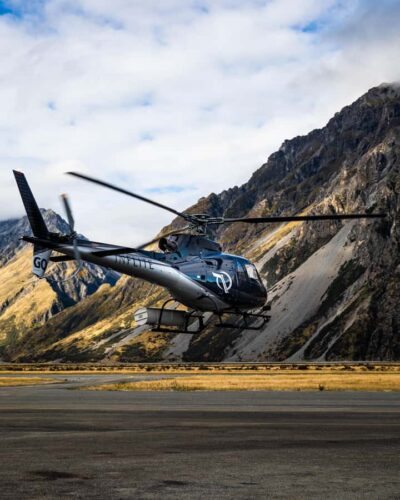
Browse the lists this tour appears in